Connect with NCR-Accredited Experts and Take Control of Your Finances. When monthly payments start to feel overwhelming, debt review can be a lifeline — but only if it’s done right.

Credit Mediation is a practical way for South Africans to deal with difficult debt situations without immediately entering a formal court-driven process. Instead of ignoring payment problems, this service focuses on engaging your creditors early, restructuring what you owe where possible, and aiming for realistic payment terms that match your current income and expenses. It is particularly useful if you are experiencing pressure from several accounts, but still have some capacity to pay and want to avoid more serious collections steps.
Many decision-makers delay taking action until accounts are in arrears, interest has built up, and collection costs are added. By using structured Credit Mediation, you create space to negotiate, improve communication with creditors, and work towards outcomes that may reduce pressure on both your cash flow and your time. The process is confidential and guided, so you are not left to manage difficult calls and emails on your own.
With organised Credit Mediation, your full financial position is reviewed before any proposals are made to creditors. This reduces the risk of agreeing to instalments that are affordable on paper but unsustainable in real life. A mediator looks at your income, fixed expenses, and outstanding balances, and then prepares a structured view of what can reasonably be paid monthly.
Once your situation is clear, the mediator starts engaging your creditors to seek more manageable terms. While no outcome can be guaranteed, the goal is to find mutually acceptable arrangements that keep your accounts active where possible and avoid unnecessary legal escalation.
Wealth Creatives is an independent platform that helps you access specialised debt solutions through trusted partners across South Africa. We are not a law firm and we do not provide legal or financial advice; instead, we focus on helping you reach vetted professionals who work with Credit Mediation and related services daily. This allows you to compare options and choose a route that fits your situation, without spending hours searching online.
Through our network, you can explore standalone Credit Mediation or consider whether another approach, such as a regulated review process, might be more suitable. Our role is to simplify the first steps, explain the different paths in plain language, and refer you to the right specialist once you are ready. You stay in control of your decisions at every stage.
Many of our clients manage households, small businesses, or side hustles, and need clear, time-efficient guidance. By using the Wealth Creatives platform, you can connect with professionals who understand local lender practices, typical collection timelines, and the pressures South Africans face when dealing with rising living costs. This local knowledge helps keep expectations realistic and conversations with creditors grounded.
For some, Credit Mediation is the preferred option because it keeps more flexibility and can sometimes work faster than formal restructuring. Others may benefit from regulated solutions, such as structured repayment plans through overseen processes. We help you weigh these routes, so you do not feel pushed into a one-size-fits-all answer.
Certain clients discover that they are already too far in arrears for informal negotiation to be effective on its own. In these cases, it can be useful to understand how a more formal process, such as debt review services in Cape Town, could support long-term repayment management. The focus is still on restructuring what you owe, but through stricter rules and protections.
Others may find that a blended strategy is more suitable, where some accounts are mediated while others follow structured arrangements. Our partners can also explain how broader debt mediation in South Africa works for different provinces, industries, and income levels, so you are not limited by geography.
Before speaking to a specialist, many people prefer to read through practical examples and common scenarios. Our learning hub includes guides, checklists, and explanations of typical credit challenges that South Africans face. You can access these resources at any time through our curated articles and insights section, which is updated as regulations and lender behaviour change.
When you are ready to explore Credit Mediation or related support in more detail, you can reach out to our team for a confidential, no-obligation discussion. We will ask a few focused questions to understand your position and then connect you with a suitable partner who can assist further. To start that process, use the simple form and contact details on our contact page.
If your financial stress has reached a point where you can’t sleep at night, it’s time to act. Debt review can help you reclaim control, restore confidence, and rebuild your life.
It only takes a few minutes to find out if you qualify.
Start a free WhatsApp chat or complete the contact form and we will call you back.
Wealth Creatives is not a registered debt counselling firm. We connect clients to verified NCR-accredited professionals who provide debt review services in accordance with the National Credit Act.
Debt review is only safe and legal when handled by a National Credit Regulator (NCR) accredited professional. That’s why Wealth Creatives only refers clients to trusted, verified partners who follow strict industry standards and help you understand your financial situation.
Here’s what you gain:
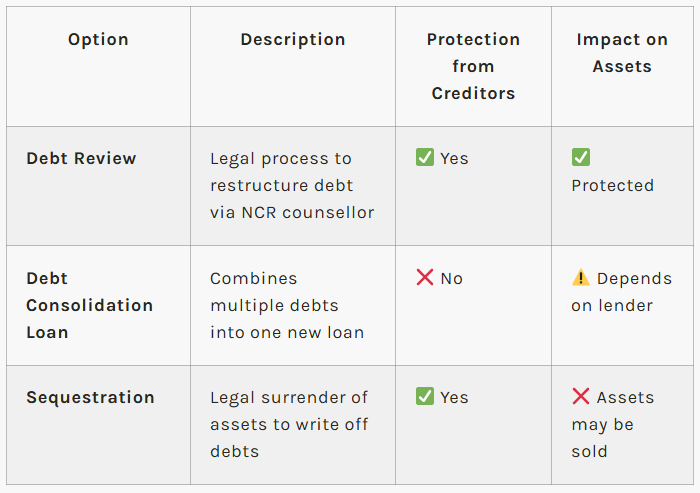
Many people confuse debt review with debt consolidation loans or sequestration. Here’s how they differ:
| Option | Description | Protection from Creditors | Impact on Assets |
|---|---|---|---|
| Debt Review | Legal process to restructure debt via NCR counsellor | ✅ Yes | ✅ Protected |
| Debt Consolidation Loan | Combines multiple debts into one new loan | ❌ No | ⚠️ Depends on lender |
| Sequestration | Legal surrender of assets to write off debts | ✅ Yes | ❌ Assets may be sold |
Find answers to commonly asked questions about debt counselling. We are here to answer all of your questions.
A trained consultant will go through the your budget and advise on the optimal affordable amount which is available to pay credit providers. This amount will be determined after the clients living expenses and those of their dependents, have been accounted for.
Our NCR accredited partners do not recommend that you exclude your home loan from the debt review process. The National Credit Act implemented the inclusion of your home loan in the debt review process, to assist consumers with keeping their homes. The NCA requires that all debt agreements are included in the debt review.
The National Credit Act implemented the inclusion of your home-loan in the debt review process, to assist consumers with keeping their homes. The NCA requires that all debt agreements are included in the debt review. In addition to including your home loan under debt counselling, the following tips should be taken into account and will assist with making sure you are able to pay off your debt in no time.
Reducing interest rates on all current debt repayments, as well as other debt expenses, with the process of debt counselling is a beneficial solution until you have paid off all of your unsecured debts and therefore, it will allow you to go back to your normal home loan repayments.
When under debt counselling it is best to include your home loan as a defined debt repayment on your home loan with being included in the debt review. The debt repayment should either be equal to or approximately 80% of the contractual repayment. This would extend the repayment terms by 20%, making the monthly debt repayment an affordable amount.
Debt counsellors will assess your credit agreements and determine whether you have been a victim of reckless lending. In the event that credit has been recklessly lent to a consumer, a court can be approached in order to declare the debt as reckless and the repayment of that debt will be written off. This will ensure that the client is placed in a better financial position and increase the affordability of their debt.
Debt counsellors will efficiently review your living expenses and financial situation by drawing up an affordable monthly budget and making sure that you have made the maximum amount of your funds available for debt review. This will give credit providers peace of mind, as they will know that a debt counsellor is contributing the consumer’s maximum amount towards settling their debt.
As per the National Credit Act, the credit providers do not have to reduce interest rates. The good news is that many credit providers are willing to reduce interest rates so that a consumer can get out of debt in a reasonable period of time.
As per the National Credit Act (NCA) credit providers do not have to reduce interest rates.
The good news is that many credit providers are willing to reduce interest rates so that a consumer can get out of debt in a reasonable period of time.
If the debt is to be settled in 60 months or under (for unsecured debts such as personal loans, store cards and credit cards) than most credit providers will accept the new payment plan. If the proposed new payment plan is over an excessive period of time, then many creditors will reject the proposal and there will be no reduction in interest rate.
You will remain blacklisted in South Africa as long as the debt is not paid, so it stays there for as long as the debt is owed.
However once the debt is paid in full, then the company that blacklisted you on ITC needs to send a letter to them informing them the debt has been paid & to give permission to remove it.
For the quickest and safest way to remove your blacklisting status in South Africa, enter the debt review process with one of our NCR accredited partners and take your first steps to clearing your name.
No you don’t have to. A formal interview conducted on one of our NCR accredited partners premises is not required in order to purchase a debt solution. Most debt related processes can be handled over the phone, however, certain documents need to be signed by clients and returned to the debt counsellor.
Signing up for an effective and trustworthy debt solution is done over the telephone and via email. This ensures that process is conducted as quickly and conveniently as possible, to save you time and money.
The application process is 100% safe and reliable, as experts financial consultants will assist you every step of the way. All personal and financial information is kept confidential and the appropriate steps are made by the company to make sure the client is protected.
On a daily basis, financial consultants and client services team are available to discuss financial queries and service related topics at any time, thus enabling you to stay on top of your debt situation.
Our NCR accredited partners also ensure that all employees follow the company values; service excellence, pride, growing people, forward thinking, integrity and accountability in order to conduct business in the most effective and ethical way.
Clients should never make any promises or arrangements with a credit provider without first discussing the matter with one of our NCR accredited partners. This tactic is often used by credit provider staff who are working under commission, or by debt collection firms working on behalf of the credit providers.
Why use a debt review solution
Our NCR accredited partners can assure you that we offer excellent service. If you are under debt review with us we would have already negotiated with your creditors on an affordable repayment plan.
To date, they have helped thousands of clients and are currently achieving a 90+% success rate.
If a credit provider or debt collector contacts you, the best option would be to contact one of our NCR accredited partners straight away and we will advise you on the best debt solution for your needs.
Never make any arrangements with a credit provider without discussing it with us first, as this can have a negative impact on your entire repayment plan with the other credit providers.
Be warned by debt collectors
Unfortunately, certain debt collectors will use dishonest and illegal tactics in order to trick you into defaulting on your debt review payments in order to pay them instead.
Be aware as debt collectors may pretend that you are not under debt review or that they have terminated your debt review. They are by no means allowed to take this sort of action.
Therefore, if you are at all concerned or confused at any time whilst under debt review, it is vital that you contact one of our NCR accredited partners.
You are able to move and work overseas, however, our partners insist that clients advise them beforehand. As long as clients continue to make monthly payments, they can stay on the debt repayment plan
The following steps map out the process involved with purchasing an item on credit, applying for a loan, or extending the credit limit on your store card and the actions taken by credit providers and credit bureaus.
The credit process differs according to the type of credit you wish you apply for.
The following steps map out the process involved with purchasing an item on credit, applying for a loan, or extending the credit limit on your store card and the actions taken by credit providers and credit bureaus.
Steps of the credit process
For more assistance with the credit process or any questions with regards to sorting out your financial situation, specifically solving your debt contact ezDebt
Our NCR accredited partners operates nationwide, telephonically or online. For more details click here
However, they have attorneys in every jurisdiction of South Africa. Thus, there is no need to meet with clients in person and all that is needed is the client’s documentation, which we will be used to liaise directly with the banks.
Debt review, Administration and Sequestration are viable debt solutions, however, Debt Review is the only option offered to South African consumers struggling to make their debt repayments are faced with financial difficulty.
Debt review, Administration and Sequestration are viable debt solutions, offered to South African consumers struggling to make their debt repayments are faced with financial difficulty. All debt solutions are implemented through systematic business processes, however, they have several differentiating factors.
Administration:
Administration is a debt solution implemented whereby the client’s current debt instalments are reduced and the credit providers receive a debt repayment once every three months. It is a legal process whereby the debt repayment terms are extended, but the downfall lies with the fact that the process is lengthy and takes much longer than debt counselling.
Sequestration:
Sequestration is another debt solution but is not offered. The process entails selling an individual’s current assets in order to pay off or lessen their current debt. In addition to this, the court will appoint someone to manage the client’s money and thus, it is an expensive process.
Debt Review:
Debt review is a debt management solution implemented in order to assist South African consumers with solving their debt problems. The process of debt review will ensure that the client’s debt repayment plan is extended and their current interest rates are reduced, as a professional ezDebt financial consultant will negotiate with the client’s credit providers. The following information sums up the debt review process:
Debt review, administration and sequestration are all solutions targeted at solving the debt problems South African consumers currently face.
The documents may be an S129 letter informing the client that legal action has started, or a summons has been submitted.
Debt consultants will be able to assist you in taking the right course of action. The documents may be a S129 letter informing the client that legal action has started, or a summons has been submitted. Either way, credit providers cannot start legal action if the client has applied for debt review before they send the S129 letter.
Our partners suggest that clients advise the credit providers that they have applied for debt review in terms of section 86 of the National Credit Act. If the credit providers ask for proof, clients will be able to show them their receipt.
If the credit providers ask for proof, you will be able to show them the receipt. If the credit providers do not desist in this practice, please send a complaint through to www.ncr.org.za.
On many occasions, credit providers sell their books of debt and thus, clients can be harassed by another debt collector. Debt collectors still have to follow the national credit act, therefore allowing clients the right to threaten to report them.